

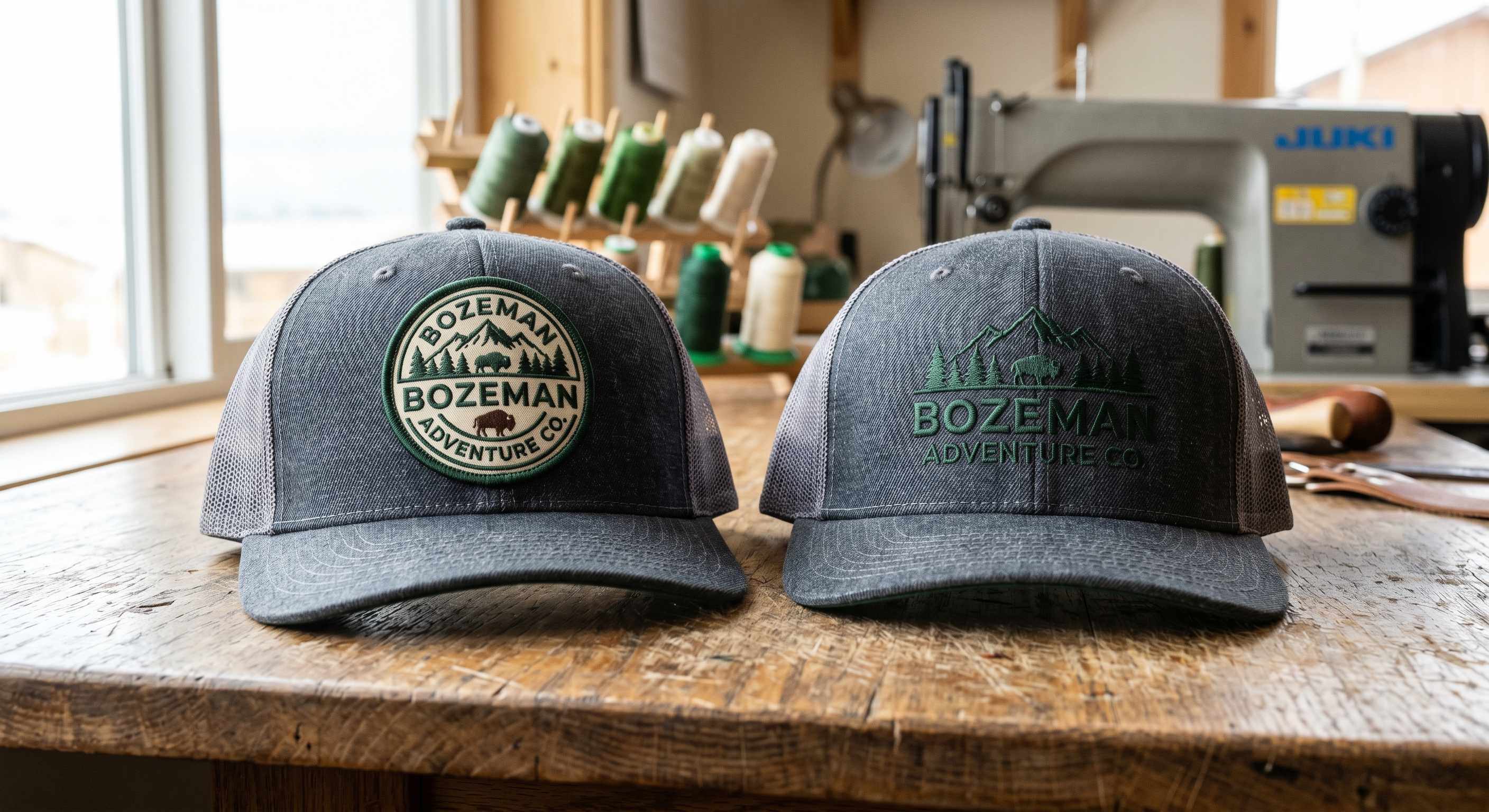
A year ago, an outdoor apparel owner in Bozeman ordered 18 "embroidered hats" for a trade show, expecting the twill-patch, merrowed-edge look his mood board had been built around. What arrived was 18 cleanly direct-stitched trucker caps. The logo was crisp. The aesthetic was wrong. Two weeks later he reordered 24 of the same cap as embroidered patch hats, and the same logo suddenly read deliberate instead of corporate.
That confusion is the entire reason this article exists. "Embroidered patch hats" and "embroidered hats" sound like the same product and are not. One is a pre-made thread patch sewn onto the hat. The other is thread stitched directly through the hat fabric. The choice between them is aesthetic, practical, and driven by order size in ways most buying guides skip. By the end of this guide you will know which one you are actually ordering, how each is built, and when the patch is the right call. If you already know which you want, you can browse custom patch hats and start designing.
Embroidered Patch Hats vs. Embroidered Hats: What's Actually Different
An embroidered patch hat starts with a patch. A rectangular, circular, or shield-shaped piece of woven twill gets mounted in an embroidery hoop, fed through a machine that lays thousands of thread stitches onto its surface, and finished with a border. That finished patch is then sewn, heat-pressed, or both, onto the front panel of the hat. The patch is a separate object before it ever touches the hat.
An embroidered hat skips the patch entirely. The hat is mounted in the machine, and the needle drives thread directly through the front panel fabric into a backing behind it. No substrate, no border, no separate piece. The design lives in the hat.
The physical consequence matters. An embroidered patch sits slightly proud of the crown with a visible edge. Direct embroidery is flush with the fabric and reads quieter. On a curved front panel, patches are noticeably dimensional; direct stitching disappears into the weave. Both are thread-based. One is a layered object, the other is a surface treatment.
How an Embroidered Patch Is Built
 The patch starts as a base fabric, usually a tight twill in white or a solid color. The machine stitches the design across the surface, building up fills, satins, and outlines thread by thread. When the stitching is done, the patch gets an edge treatment, and this is the first real decision a buyer rarely knows they are making.
A merrowed edge is a wrapped overlock stitch run all the way around the perimeter. It is thicker, around 2 to 3 millimeters, and gives the patch a visible rope of thread at its border. It reads traditional, rugged, and uniformed-service. Fire departments, athletic teams, and heritage outdoor brands almost always ask for merrowed.
A laser-cut edge, sometimes called hot-cut, is sealed flat by a laser that melts the substrate edge as it cuts. It is thinner, around 1 millimeter, flatter, and reads modern and clean. It pairs well with non-traditional patch shapes, because merrowing struggles with tight interior curves.
The patch then attaches to the hat in one of three ways: a sewn border stitched through the hat fabric, a heat-seal adhesive backing bonded under pressure, or both together. The best-built patch hats use both. Heat seal bonds the whole patch flush against the crown so it does not pillow. A sewn border does the structural work and keeps the patch there for the life of the hat. Ready to see both edge styles on a real cap? Shop custom patch hats to preview either option in the design tool.
How Direct Embroidery Is Built

Direct embroidery is simpler to describe and harder to get right. A cap frame clamps the hat in place, a multi-needle head loaded with thread colors drops into position, and the machine drives each stitch through the front panel fabric into a backing that stabilizes the area. Everything about the final look is determined by stitch choice: flat satin for clean wordmarks, tatami fill for solid shapes, running stitches for outlines, and 3D puff where a dense foam is placed under the satin to lift bold letterforms off the hat. There is no patch, no substrate, and no border. When the needle stops, the design is already finished and fused into the cap. If direct embroidery is the aesthetic you are actually looking for, browse custom embroidered hats instead.
Same Logo, Two Different Meanings

Take a single wordmark with a strong icon. Stitched directly into a navy trucker, it reads crisp, quiet, and corporate. It is the kind of hat a sales team hands out at a conference and nobody mentions. Take that same wordmark, build it as an embroidered patch on a twill square with a merrowed border, and apply it to the same trucker. It now reads vintage, crafted, and deliberate. People ask where you got it.
This is what the outdoor brand owner in the intro was reaching for. He did not dislike direct embroidery. He just wanted the patch to read as a patch, because the patch look is half the branding. If your logo would feel more at home on a workshirt chest, a guitar case, or a tacklebox than on a polo, an embroidered patch is probably the right call. If the design should feel integrated into the hat rather than pinned to it, direct embroidery wins without competition.
How to Pick: Practical Decision Points
Three factors settle most of these decisions before aesthetic preference even enters the room.
Order size. Embroidered patch hats start at 24 units at Griwolfe because each patch run has fixed setup costs that only amortize at a minimum quantity. Direct embroidery starts at 6 units. If you are ordering 12 hats for a small team, a first pop-up, or a client gift, direct embroidery is the only math that works. If you are ordering 50 or more, the per-unit math on patches is competitive.
Placement. Embroidered patches go on the front panel. That is it. Back-panel branding, side-panel hits, and curved bill embroidery all require direct stitching, because the patch attachment process does not translate to those areas at scale. If your design calls for a small logo on the side and a wordmark on the back, you are building an embroidered hat, not a patch hat.
Hat style. Structured trucker and 5-panel caps carry embroidered patches cleanly, because the flat front panel gives the border a stable surface to sit against. Dad hats and unstructured caps work with a slightly softer read. Beanies require hand-stitched borders on simple patch shapes, since heat-seal adhesive does not bond to knit. For a broader walkthrough of how patch types map to every hat style, see the patch hats guide.
Where Other Patch Types Fit
Embroidered patches are one of five patch types. If your logo has fine text under 8 points, hairline serifs, or intricate line work you cannot afford to lose, a thread-based patch is not the right move at all, and a different construction handles that detail better. See woven patch hats for that comparison in full.
Frequently Asked Questions
Is an embroidered patch more durable than direct embroidery?
On the hat itself, both are close to permanent under normal rotation. The difference is repairability. A patch that tears or fades can be unstitched and replaced without touching the cap. Direct embroidery is the cap. If the design needs to change, you replace the hat, not the stitching.
Should I pick a merrowed edge or a laser-cut edge for my hat patch?
Merrowed reads traditional and handles years of abrasion without fraying. It is the default for uniformed groups, athletic teams, and heritage brands. Laser-cut reads modern, sits flatter against the hat, and pairs well with shapes merrowing struggles to wrap, like tight stars or interior curves.
Can I put an embroidered patch on the back of a hat?
Practically, no. Back panels on most caps are curved, seamed, or adjustable, and patch attachment does not hold cleanly on that geometry. For back-panel branding, direct embroidery is the answer. Keep patches on the front panel where they belong.
Why is the minimum order 24 for an embroidered patch when direct embroidery starts at 6?

Each patch run has one-time production costs that only make sense at a minimum quantity. Direct embroidery skips that step entirely, so the floor drops to 6 units. Below 24 hats, direct embroidery is usually the only viable path. Above 24, both are open.
Bringing It Together
Embroidered patch hats are not a fancier version of an embroidered hat. They are a different product, built differently, chosen for a different reason. The patch is a separate object with a twill base, a merrowed or laser-cut border, and an attachment that reads deliberate against the crown. Direct embroidery fuses the design into the hat and reads quieter. Pick the patch when the patch look is part of the branding, when your order is 24 or more, and when the front panel is the only placement you need. Pick direct embroidery when the order is small, the placement varies, or you want the logo to feel integrated rather than applied. Either way, you can design your custom patch hat in the tool and preview the finished look before committing.
Share:
Sublimated Patch Hats: Full-Color Printed Patches for Complex Designs
Embroidery vs. Patch Hats: Which Customization Method to Choose